


I Wanted Better Science Discussions. Turns Out I Had to Teach Kids How to Have Them.
Ah, teachers. The most magical time of the year: those few weeks before school starts when we are still filled with dreams and aspirations about how absolutely phenomenal our science classes are going to be this year. So naturally, here is what I have spent the last couple of weeks designing:
A SCIENCE TALK RUBRIC!
Please read that with an unreasonable amount of enthusiasm.
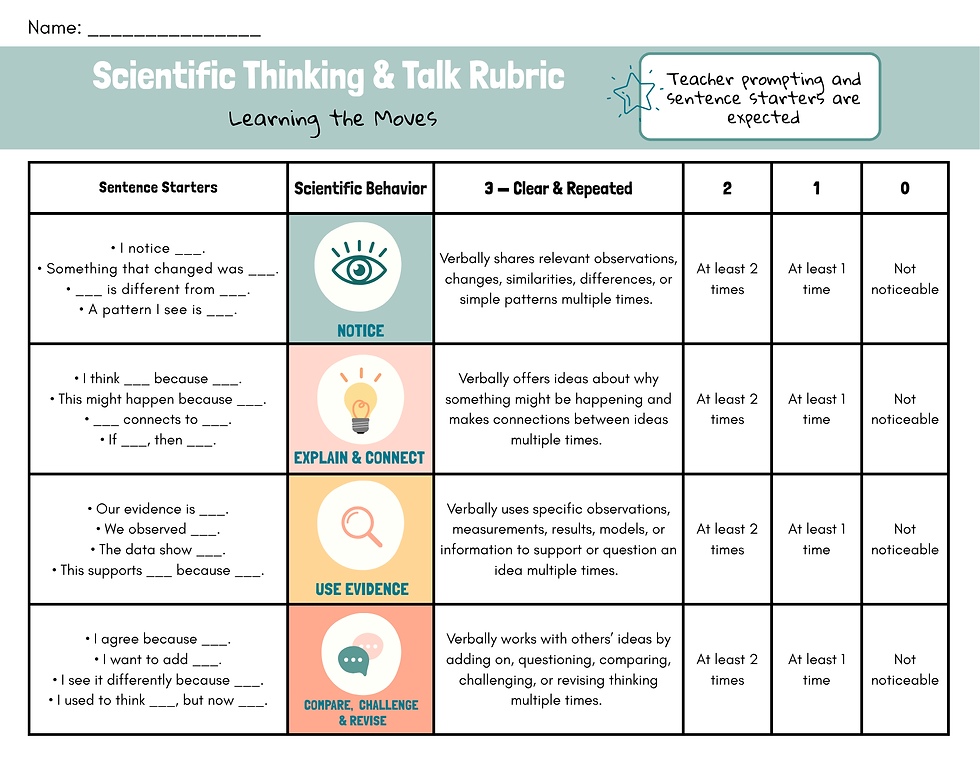
Over the last few years, I have become increasingly enamored with the Ambitious Science Teaching framework. I love the idea of students figuring things out together—building explanations, working with evidence, challenging ideas, revising their thinking, and actually doing science instead of waiting for me to explain it to them. But here's the tricky part: that kind of classroom requires a lot of productive student talk.
And I've realized that this is where a lot of my students get stuck.
I can design the coolest investigation in the world, put something genuinely puzzling in front of them, and tell them to discuss their ideas…but that doesn't mean they actually know how to do that.
And really, why would they? We tell kids things like participate, work with your group, share your thinking, and use evidence all the time. But most students do better when they know exactly what they're supposed to do. Scientific talk is a skill, and if I expect students to use it, I probably need to actually teach it.
So I created the Scientific Thinking & Talk Rubric to do exactly that.
Conveniently, it also helps with another classroom headache: the dreaded participation grade.
I've heard plenty of pushback about grading participation—and some of that pushback is completely fair. "Participates in class" is incredibly vague. Instead, this system shifts the focus away from whether a student is simply talking and toward specific, observable scientific behaviors.
The rubric teaches students four moves:
NOTICE — Bring important observations, patterns, changes, similarities, or differences into the conversation.
EXPLAIN & CONNECT — Share what you think might be happening and connect ideas together.
USE EVIDENCE — Point to observations, measurements, data, models, or other information to support or question an idea.
COMPARE, CHALLENGE & REVISE — Work with someone else's thinking by adding on, questioning, comparing, challenging, or changing an idea.
That's it. Four moves.
And if you want to try this without committing to an entire new classroom system in the middle of your back-to-school optimism, I made the introductory rubric a freebie. It includes all four moves, sentence starters for students, and the most supported version of the scoring system. Print it. Try it during a lab. See what happens when "participate" suddenly has an actual definition.
Because students are learning these moves, I also don't expect instant independence. In the introductory version, teacher prompting is completely fair game. If I ask, "What changed?" and a student notices something meaningful, that counts. If I ask, "What evidence makes you think that?" and they can point to a result, that counts too. I'm teaching the behavior first. Independence can come later.
I can even choose just one move to focus on during a lab instead of trying to listen for everything at once.
Beginning a new phenomenon? Focus on Notice.
Trying to figure out why something happened? Explain & Connect.
Looking at results? Use Evidence.
Debating explanations? Compare, Challenge & Revise.
Suddenly, "participation" becomes a whole lot less mysterious. I'm not asking, Did this kid talk enough? I'm asking, Is this student learning how to think and talk like a scientist?
And that is a classroom behavior I actually want to teach.
But I Don't Want Them Using Sentence Starters Forever
Neither do I friends. The goal isn't to hand students a sentence starter in September and still have them dutifully reading "I notice..." off a piece of paper in June. The scaffolds should fade.
That's why I also built the full Scientific Thinking & Talk Rubric System around the same four moves. Instead of changing the expectations every few months, the scientific behaviors stay familiar while the support gradually decreases.
Students begin with teacher prompting and sentence starters expected. As they get better at entering scientific conversations, the prompting fades and the level of independence increases.
The full system includes three developmental versions of the rubric, increasingly sophisticated sentence starters, teacher implementation directions and scripts, and projectable Scientific Thinking & Talk Focus Slides for each of the four moves.
Basically: the moves stay the same. The support fades. The thinking grows. So if you just want to experiment with this idea, start with the free rubric. If you're thinking, No, this is actually something I want to intentionally teach all year, then the complete Scientific Thinking & Talk system is here.
[See the complete Scientific Thinking & Talk Rubric System here.]
Because if we're going to spend all year asking kids to talk like scientists, it seems only fair that we teach them what that actually means first.


Comments