



Lunar Larceny | Moon Phases Investigation & Detective Lab
$5.00Price
No Reviews YetShare your thoughts.
Be the first to leave a review.
Students can name a waxing crescent on a worksheet. But can they recognize the same phase when the diagram changes—or use it to solve a problem?
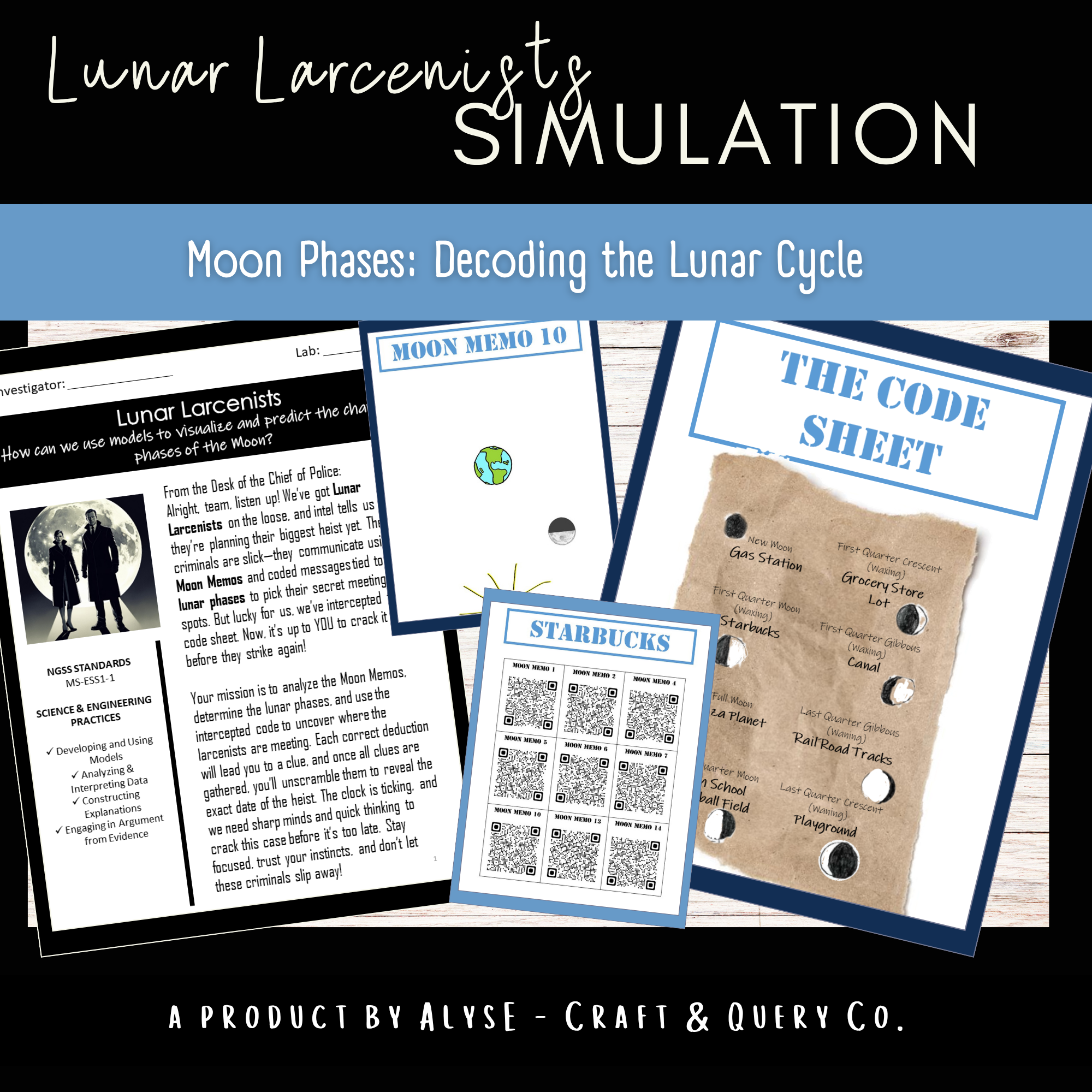
That's the thinking behind Lunar Larceny. Students become detectives tracking a group of lunar criminals who communicate through Moon Memos. Every phase they identify sends them to a location, where they collect clues about the next heist. Once the evidence is assembled, students use a lunar calendar to narrow down the date.
The mystery gives repeated moon-phase practice a purpose. Students aren't just memorizing illuminated shapes; they're using observations to make decisions and check their thinking. Optional 3-D Moon models add another perspective for students who need to see the geometry.
Analyze intercepted Moon Memos and diagrams to identify lunar phases.
Use phase information to connect each memo to a possible meeting location.
Work through the detective packet, compare representations, and assemble evidence for the investigation.
Explain their decisions using the relative positions and illuminated portions of the Moon.
I designed this for the student who recognizes a familiar moon-phase picture but gets lost when the perspective changes. The Moon Memos ask students to identify a phase, use it as a code, and check whether their interpretation leads to the right clue. That immediate feedback makes misconceptions visible without stopping the whole class.
Students work at different paces while I can circulate and ask why they chose a phase. The optional painted-sphere models connect two-dimensional drawings with the Sun–Moon–observer geometry, so the lab can build spatial reasoning as well as recall.
Eight-page Lunar Larcenists student investigation PDF and matching teacher key.
Printable Moon Memos and virtual location sheets.
Two-page teacher setup and facilitation guide.
Classroom board display in PDF and PowerPoint formats.
Audience: Middle and high school Earth & Space Science. Focus: Moon phases, interpreting lunar diagrams, spatial reasoning. Format: PDF and PowerPoint. Optional painted-sphere models and classroom stations; see setup guidance.