


Finally, a Space Unit That Makes Sense to Me
How I'm designing an inquiry-based Earth & Space Science unit where students actually have to figure things out.
Here's a fun little problem with teaching space: we're standing on a giant, spinning, tilted rock that's hurtling around the Sun, while a Moon circles us, the stars appear to move, and the oceans rise and fall. And we're supposed to explain all of that to ninth graders. Preferably before the end of the marking period.
I've been putting a LOT of thought into how I want to structure my first major Earth & Space Science unit this year. Not just what I want students to learn, but how I want them to figure it out. Because there's a difference.
I could start with vocabulary. Rotation. Revolution. Orbit. Axis. Tilt. Have students draw some diagrams, take some notes, and answer questions about Earth's movements. And we'd probably get through the material a whole lot faster. But there's something that bothers me about that approach: knowing that Earth rotates isn't the same thing as understanding how we know Earth rotates.
And that little distinction has become the driving force behind how I'm designing this unit.
First, Let's Make Them Question Something They Think They Know
Most of my students already know that Earth rotates and revolves around the Sun. Great! Wonderful! Gold stars for everyone. But here's the thing: when we look up at the sky, it certainly doesn't look like we're moving. The Sun rises, the Sun sets, and the stars travel across the night sky. So how do we know what's actually moving?
That's where my first investigation, Can We Catch Earth Moving?, begins. Students use physical manipulatives to build and test competing models of the Earth–Sun system. By moving a model Earth, Sun, and observer into different positions, they can actually visualize what's happening in space and begin building a mental model of how these movements might explain what we see in the sky. Rather than simply looking at a diagram and being told what happens, they're physically working through the possibilities, testing their ideas, and figuring out what makes sense.

Then comes the evidence. Students investigate star trails, the Foucault pendulum, and changes in the stars we can see throughout the year. They return to their models to see which explanations still hold up and which need to change. They're not simply learning which explanation is correct. They're developing a picture of what's happening in space in their own minds—and using evidence to figure out why one explanation works better than another.
And here's the part I love: A model can explain one observation perfectly well and still be incomplete. The idea that the Sun moves around Earth can account for the apparent daily movement of the Sun. But what happens when we introduce other evidence? What about the changing constellations throughout the year? What about a pendulum that appears to change its direction of swing? Suddenly, students have to do more than remember a fact. They need to decide which explanation actually holds up.
That's science! And it's a much more interesting starting point than asking students to copy down the definition of rotation.
Okay, So Earth Moves. Now What?
Once we've established that Earth rotates and revolves around the Sun, we could move on to another topic. Except I don't want to. I want students to see that figuring out Earth's movement was just the beginning. Now we can use that understanding to investigate something else.
Enter: The Mystery of the Mixed-Up Seasons.
Students are presented with photographs of places experiencing dramatically different conditions during the same month. Wait. How can it be summer here and winter there? And perhaps more importantly, what would we need to figure out to explain it? Rather than immediately announcing that Earth's tilt causes seasons (congratulations, mystery solved in 11 seconds), students investigate how light behaves. They experiment with concentrated and spread-out energy, consider Earth's curved surface, explore latitude, and eventually put the pieces together to explain seasonal differences. Each activity helps them figure out another piece of the puzzle, but the explanation isn't handed to them before they've had a chance to do the thinking.
Along the way, we stop to build consensus models. These are important because I don't want students completing one activity, turning the page, and promptly forgetting everything they just figured out. We bring our discoveries together, agree on what the evidence supports, and create a visual record that goes into their science notes. Students can return to those notes as they build increasingly sophisticated explanations.
The goal isn't to complete a bunch of activities about seasons. The goal is to build an explanation that actually works.
And ideally, by the end, students can explain why winter in New York doesn't mean winter everywhere on Earth without simply telling me, "Because it's tilted." Technically true, but we're going to need a little more than that.
The Moon Has Entered the Chat
Now that students have experience using models to explain Earth's movement, we're going to put those skills to work again. Moon phases, eclipses, and predictable patterns all give students opportunities to apply the same kind of reasoning to a different system.
The topics are different, but the thinking is familiar. What's moving? What are we observing? Where must the Sun, Earth, and Moon be positioned to produce what we see? Why do Moon phases repeat? Why don't eclipses happen every month? Instead of treating these as completely separate collections of facts and vocabulary, I want students to recognize that they're using the same scientific thinking they've already been practicing.
I especially like that this gives us opportunities to return to earlier models and ask whether they're sufficient to explain something new. Students might understand that a solar eclipse occurs when the Moon moves between Earth and the Sun, but that explanation alone doesn't tell us why we don't experience a solar eclipse every month. There's another piece of the model we need to consider: the Moon's tilted orbit.
This is exactly the kind of moment I want more of in my classroom. Students realize that their explanation isn't necessarily wrong, but it isn't complete yet. New evidence or a new question means the model needs to become more sophisticated. And back to the model we go.
And Somehow, We End Up at a Hurricane
Because apparently spinning planets, mysterious seasons, and disappearing Suns weren't enough, we're finishing with tides. This is where I really want students to recognize the power of understanding predictable patterns. We'll investigate how the Moon's gravity, the Sun's gravity, and Earth's rotation relate to the tides we experience. Students will examine high and low tides, spring and neap tides, and the repeating patterns we can use to make predictions. They'll have opportunities to observe simulations, work with data, and use models to explain why tides aren't the same every day.
Then we'll connect that understanding to hurricanes and coastal flooding, including Superstorm Sandy. Why might the timing of a storm matter? Could an already elevated tide make flooding worse? How could understanding the positions of Earth, the Sun, and the Moon help us anticipate especially high tides?
Suddenly, these aren't just diagrams of the Moon and Earth with arrows pointing everywhere. Students are using what they've figured out to make sense of something that actually affects people. And I love the idea that a unit that began with students wondering whether Earth is moving ends with them using that understanding to investigate a real-world problem.
Here's the Part I'm Really Trying to Get Right
Inquiry sounds lovely on paper. Students ask questions! They investigate! They construct explanations! Cue the inspirational teaching montage. But here's what I think sometimes gets lost in conversations about inquiry-based learning: Good inquiry takes an enormous amount of intentional planning. Students need opportunities to figure things out, but they also need enough structure to make meaningful progress. And just because students participated in an engaging investigation doesn't mean they automatically understood the science or will remember it next week.
That's the balance I'm trying to get right as I design this unit. I'm drawing heavily on Ambitious Science Teaching practices, particularly the idea that students should develop, test, and revise explanations over time. I'm also trying to be much more intentional about what happens between the exciting investigations, because that's often where I think learning can fall apart.
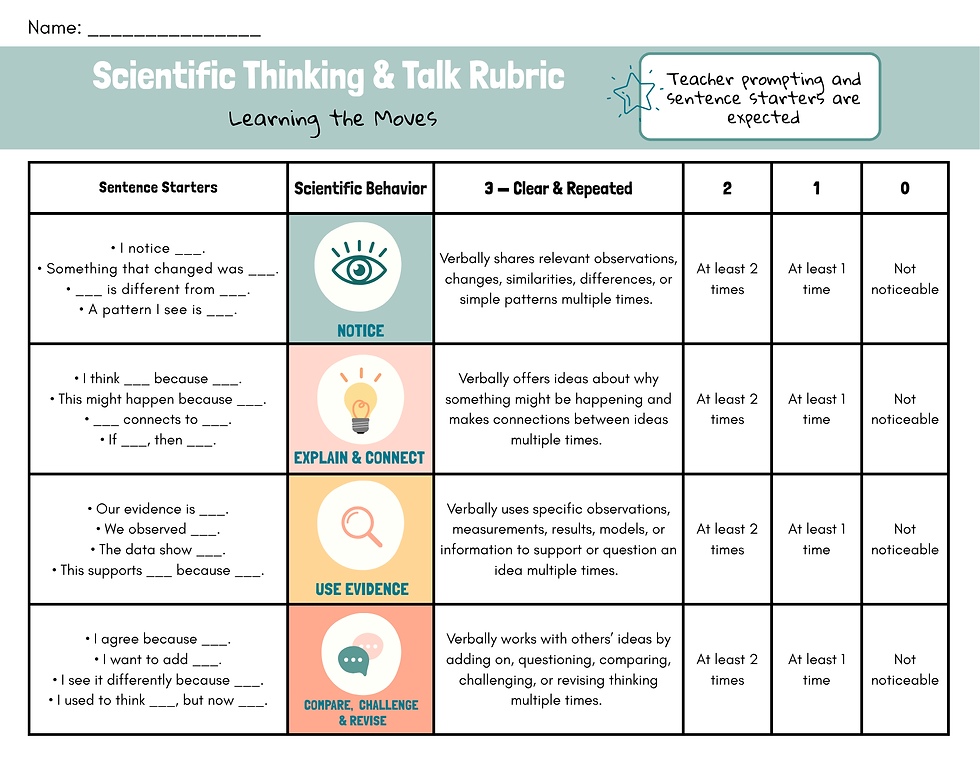
I'm building in short retrieval activities that I call Brain Stretches, opportunities for students to talk through and challenge ideas, and consensus models that become part of their science notes. These aren't just extra worksheets to keep everyone busy. They're designed to help students remember what they've already figured out, connect ideas that might otherwise remain separate, and have something meaningful to refer back to when they're asked to build a more complex model.
The consensus modeling piece is especially important to me. I don't want to assume that because students completed a flashlight investigation, they automatically understand how sunlight angle relates to energy concentration and temperature. We need to stop, talk about what the evidence actually showed, and decide together what belongs in our developing explanation. That becomes a reference point for the next investigation rather than something we leave behind.
I'm also thinking carefully about how much information to give students and when. If I explain everything before an investigation begins, there's not much left for them to figure out. But if I provide too little direction, we're just wandering around in the dark with flashlights. Literally, in the case of the seasons investigation. The challenge is creating enough scaffolding to make inquiry productive without accidentally doing all the thinking for students.
I'm Trying to Build a Story, Not Just a Unit
The biggest change in my planning is that I'm no longer thinking of rotation, revolution, seasons, Moon phases, eclipses, and tides as a checklist of topics to cover. I'm thinking about how each investigation can help students make sense of the next one.
We begin by questioning what appears to be happening in the sky. We gather evidence that Earth moves, then use our understanding of that movement to investigate why different places experience different seasons. We extend our thinking to the Moon, where changing positions produce predictable patterns, and eventually use those patterns to make sense of tides and coastal flooding.
The individual investigations still have their own questions, activities, and learning goals, but they're connected by a larger purpose. Each time students encounter something new, they should have ideas and reasoning tools they can bring with them. They're not starting from scratch every time we turn the page.
And importantly, I'm not trying to eliminate direct instruction. Sometimes students need a clear explanation. Sometimes they need vocabulary, guided notes, or a worked example. The difference is that I want those things to support the sensemaking, rather than replace it before it has a chance to happen.
Will every lesson go exactly as planned? Absolutely not. I teach teenagers. Will someone still tell me that summer happens because Earth is closer to the Sun? Almost certainly. Will I occasionally wonder why I didn't just hand everyone a diagram and call it a day? I think we all know the answer to that. But my hope is that by the end of this unit, students can do more than list facts about space. I want them to look at something happening in the sky, recognize a pattern, and begin asking themselves what could explain it. I want them to understand that scientific models are tools for thinking, not just pictures we draw after someone tells us the correct answer.
Most of all, I want my students to experience what it feels like to figure something out, rather than simply be told how the universe works.
And if they can explain seasons without mentioning Earth's distance from the Sun, I'll consider that a pretty solid bonus.


Comments